What’s in This Guide
- Why Property Taxes Deserve Extra Attention in Brookfield Right Now
- How Brookfield Calculates Your Property Tax Bill
- How Escrow Turns an Annual Tax Bill Into a Monthly Cost
- How Property Taxes Affect Your Listing Strategy as a Brookfield Seller
- How to Check a Property’s Taxes Before Making an Offer: Step by Step
- Questions to Ask Before Making an Offer on a Brookfield Home
- Why Local Knowledge Matters When Taxes Enter the Conversation
- Frequently Asked Questions
- Ready to Plan Your Purchase or Sale Around the Real Numbers?
A buyer finds a Brookfield listing, runs the mortgage numbers, and moves toward an offer. Then the lender adds the property tax escrow, and the monthly payment jumps by several hundred dollars.
On the other side of the transaction, a seller prices a home without realizing the assessment on record is about to change. Brookfield, CT, real estate agents see both situations regularly, and both come down to the same gap: most people do not know how Connecticut property taxes actually work.
This guide explains assessed value, mill rates, revaluation, and escrow in plain terms, so buyers and sellers in Brookfield can plan around real numbers instead of surprises.
Quick Facts
- Brookfield property taxes use assessed value and the town mill rate.
- Connecticut generally taxes 70% of a property’s market value.
- One mill equals $1 per $1,000 of assessed value.
- The annual bill is assessed value times mill rate, divided by 1,000.
- Divide the annual total by 12 for a monthly estimate used for preliminary home affordability planning purposes.
Why Property Taxes Deserve Extra Attention in Brookfield Right Now
Property taxes are an important part of the total cost of buying a home in Brookfield. Recent rate changes and the town’s revaluation process make it especially important for buyers to review current tax information before comparing properties.
Mill Rate Changes Can Raise Carrying Costs
Changes to Brookfield’s mill rate can affect the annual tax bill attached to a property. Buyers should include those costs when estimating monthly payments and long-term affordability.
Revaluation Can Change Assessed Values
A townwide revaluation may adjust how properties are assessed based on current market conditions. That can affect future tax bills even when the mill rate itself changes only modestly.
Nearby Towns May Have Different Tax Costs
Similar homes in Brookfield, Danbury, Bethel, and New Milford can carry different annual property tax obligations. Buyers comparing Brookfield real estate with nearby markets should look beyond the listing price.
Local Tax Context Helps Buyers Compare Homes
A local real estate agent can help buyers review assessed values, recent tax bills, and town-level differences. This gives relocation buyers and local movers a clearer picture of the full cost of ownership.
How Brookfield Calculates Your Property Tax Bill
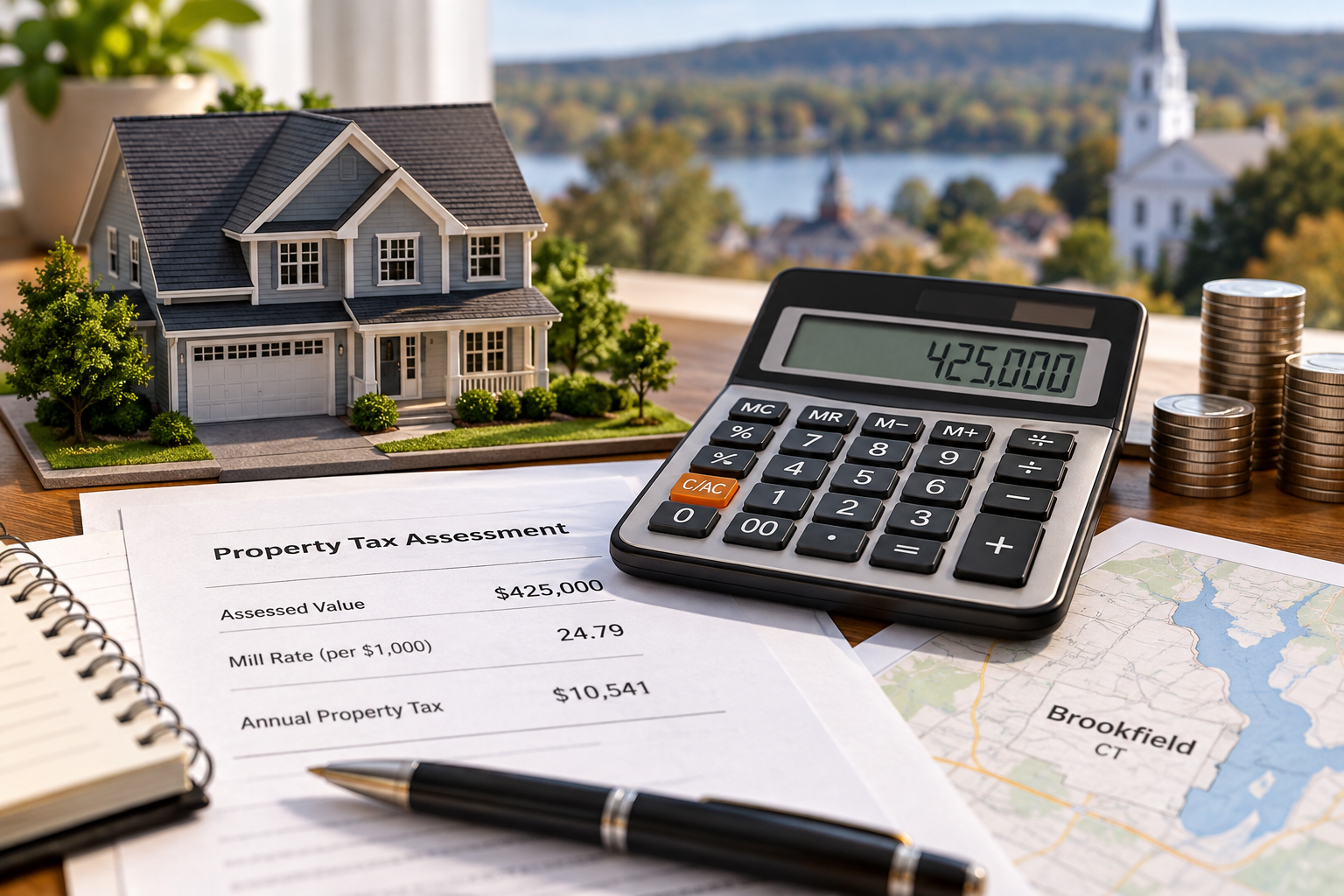
Brookfield, CT, property taxes are based on the property’s assessed value and the town’s mill rate. The basic formula is the assessed value multiplied by the mill rate, divided by 1,000. Buyers and sellers can verify the calculation through the town’s property tax calculator.
Start With the Property’s Estimated Market Value
The Brookfield Assessor determines a property’s value using available property information and market data. Brookfield is also conducting a townwide revaluation in 2026, which may update the values used for future assessments.
Apply Connecticut’s 70% Assessment Ratio
Connecticut municipalities generally assess real property at 70% of its fair market value. For example, a home valued at $500,000 would have an assessed value of approximately $350,000 before exemptions or other adjustments are considered. The town’s calculator specifically directs property owners to use the 70% assessment figure.
Use Brookfield’s Applicable Mill Rate
A mill equals $1 in tax for every $1,000 of assessed value. The Brookfield Assessor currently identifies 29.97 mills as the 2025 mill rate, meaning the town applies $29.97 for each $1,000 of taxable assessment. The Board of Finance sets the rate through the municipal budget process. Property owners should confirm the applicable rate because it may change from year to year.
Divide the Result by 1,000
Using a $350,000 assessed value and a 29.97 mill rate, the calculation would be:
$350,000 × 29.97 ÷ 1,000 = $10,489.50 per year
This provides a general estimate of the property’s annual Brookfield tax bill before any applicable exemptions, credits, or special charges.
Convert the Annual Bill Into a Monthly Estimate
Dividing the estimated annual bill by 12 produces a monthly planning figure of about $874. This can help buyers compare the total monthly cost of Brookfield homes, although the amount collected through mortgage escrow may be adjusted by the lender.
How Escrow Turns an Annual Tax Bill Into a Monthly Cost

Most Brookfield homeowners never write a check directly to the Tax Collector. Instead, their mortgage servicer collects one-twelfth of the estimated annual tax bill each month through an escrow account and pays the town when the bill comes due.
In Brookfield, real estate taxes come due July 1 each year.
Escrow makes taxes feel invisible until they change. After a mill rate increase or a revaluation, the servicer recalculates the monthly escrow portion, and the total mortgage payment moves with it.
Buyers should also know that lenders count the escrow amount when measuring debt-to-income ratios, so a higher tax bill can reduce the loan amount a buyer qualifies for. Anyone planning a purchase budget should treat the tax line as a first-class number, not an afterthought.
READ MORE: How Much House Can You Afford? Brookfield, CT Agents’ Advice
How Property Taxes Affect Your Listing Strategy as a Brookfield Seller
Buyers compare monthly cost, not just list price, so a home’s tax bill is part of its competitive position. A seller whose assessment runs high relative to similar homes may face buyer hesitation that has nothing to do with the property’s condition or presentation.
Three points matter for sellers preparing to list:
- Know your assessment before buyers ask. Serious buyers pull the town’s online property portal record early. Sellers should review their own property records for accuracy, since assessment errors can be corrected through the Assessor’s office.
- Understand where the revaluation cycle stands. Listing before or after new assessments take effect changes the tax picture a buyer sees. An experienced listing agent can frame the timing honestly during showings and negotiations.
- Price with the full monthly cost in mind. A comparative market analysis that ignores tax differences between comparable homes misses part of what buyers actually weigh.
Sellers do not control the mill rate, but sellers who understand the tax picture answer buyer questions with confidence instead of guesswork.
How to Check a Property’s Taxes Before Making an Offer: Step by Step

Any buyer can verify a Brookfield property’s tax picture in under an hour using free town resources. Follow these five steps before finalizing an offer.
Step 1: Look Up the Assessment on Brookfield’s Assessor Database
Search the property address in the Vision Government Solutions portal. Note the total assessed value and confirm the building details match what you saw at the showing.
Step 2: Confirm the Current Mill Rate With the Town
Check the current rate on the Brookfield Assessor’s page rather than relying on a listing site, since third-party platforms sometimes display outdated rates.
Step 3: Calculate the Annual and Monthly Tax Cost
Multiply the assessed value by the mill rate and divide by 1,000 for the annual figure. Divide by 12 for the monthly escrow estimate to add to your mortgage calculation.
Step 4: Check for Pending Revaluation Changes
Because Brookfield’s 2026 revaluation will update assessments, ask whether the current bill reflects pre-revaluation or post-revaluation values. The answer changes what next year’s escrow may look like.
Step 5: Factor the Number Into Your Offer and Budget
Compare the total monthly cost, including taxes, against your qualification range. A home that fits on price but strains on taxes deserves a second look before you commit.
Questions to Ask Before Making an Offer on a Brookfield Home
A short list of tax questions protects buyers from post-closing surprises. Bring these to your agent before submitting an offer:
- What is the current assessed value, and does the field card match the property’s actual condition?
- Does the tax bill reflect the October 2021 valuation or the 2026 revaluation?
- Has the current owner filed an assessment appeal, and what was the outcome?
- Are there any special charges on the bill beyond the base town tax, such as water line assessments?
- How has the mill rate moved over the past three budget cycles, and what does that suggest about the direction of the bill?
None of these questions require special access. Every answer comes from public records, and a local agent can pull them quickly.

Why Local Knowledge Matters When Taxes Enter the Conversation
Property tax estimates can vary depending on assessment practices, current rates, and local timing. Buyers benefit from guidance that reflects how taxes are actually handled in Brookfield.
Online Estimates May Miss Local Details
Generic calculators may rely on outdated information or broad assumptions. This can make projected monthly costs less reliable.
Revaluation Timing Can Affect Expectations
An active revaluation may change how a property is assessed. Local knowledge helps buyers understand when those updates may matter.
Tax Questions Often Influence Negotiations
Property taxes can affect affordability, offer strategy, and comparisons between homes. A local agent can help keep those factors in view throughout the transaction.
Ongoing Guidance Creates More Context
An experienced Brookfield real estate agent can help buyers review tax information alongside the property, neighborhood, and overall purchase plan.
➤ READ NEXT: What to Know About Buying Without a Realtor in Brookfield, CT
Frequently Asked Questions
How are Brookfield, CT property taxes handled at closing?
Property taxes are commonly divided between the buyer and seller according to the closing date. The final adjustment is usually shown in the closing documents so each party can see the amount credited or charged.
Can home improvements affect the assessed value in Brookfield?
Major additions, renovations, or other property changes may affect the assessed value. The timing and amount depend on the work completed and how the town updates the property record.
Are Brookfield condos taxed differently from single-family homes?
Condos are generally assessed as individual properties and taxed using Brookfield’s current mill rate. Association fees are separate and should be reviewed alongside Brookfield, CT, property taxes.
What happens if a Brookfield property has unpaid taxes?
Outstanding property taxes are usually identified during the title and closing process. Brookfield, CT, real estate agents can help buyers request current records, while closing professionals confirm how any balance will be handled.
Does Brookfield offer property tax relief programs?
Some homeowners may qualify for local or state programs based on factors such as age, disability, veteran status, or income. Eligibility and application requirements should be confirmed with the Brookfield Assessor.
Ready to Plan Your Purchase or Sale Around the Real Numbers?
At Lavelle RE/MAX, we know that property taxes can add another layer of uncertainty to a real estate decision. Our team helps buyers and sellers understand how local tax costs fit into the overall value and affordability of a property.
Serving Brookfield, CT, our real estate professionals provide guidance from the early stages of the transaction through closing. Whether comparing homes, reviewing property tax information, or preparing to sell, Lavelle RE/MAX helps clients move forward with clearer expectations.
DISCLAIMER: The information in this article reflects Brookfield tax figures and Connecticut assessment practices at the time of publication. Mill rates, assessments, and deadlines change through town budget cycles and revaluation. This content is provided for educational purposes only and should not be relied upon as tax, legal, or financial advice. Verify current figures with the Town of Brookfield and consult qualified professionals for guidance specific to your situation.


